Showing posts with label utopia. Show all posts

Wednesday, January 4, 2017

Fahrenheit 451

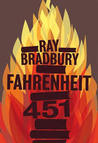
Fahrenheit 451Fahrenheit 451 by Ray Bradbury

My rating: 5 of 5 stars


Beatty wanted to die.

He wanted Montag to take that flame thrower and burn him mid-lecture. And as he writhed like a slug on the ground, some of the gibbering was in relief that he no longer had to live the charade of a fire chief who didn't want to burn books -- or bookworms -- any more than Montag did.

At least that was my feeling reading the book, this time through. And it's been a while since I read it. It's one of those books you read in high school and then put on the shelf and look at it from time to time, satisfied somehow that you read it. A long time ago. So when my daughter took it off the shelf to read it for school, I followed up with a reading once she was done.

And wow. Wow. What a book.

And while it oozes criticism of censorship and McCarthyism, it also oozes criticism of technology and the distractions it brings. The parlor shows, the drugs, the comic books, all meant to entertain without causing discomfort. And Montag revels in the destruction of it all.

"Fire!"

A great nuzzling gout of fire leapt out to lap at the books and knock them against the wall. he stepped into the bedroom and fired twice and the twin beds went up in a great simmering whisper, with more heat and passion and light than he would have supposed them to contain. He burnt the bedroom walls and the cosmetics chest because he wanted to change everything, the chairs, the tables, and in the dining room the silverware and plastic dishes, everything that showed he lived here in this empty house with a strange woman who could forget him tomorrow, who had gone and quite forgotten him already, listening to her Seashell Radio pour in on her and in on her as she rode across town, alone. And as before, it was good to burn, he felt himself gush out in the fire, snatch, rend, zip, rip in half with flame, and put away the senseless problem. if there was no solution, well then now there was no problem, either. Fire was best for everything!

Fire cleanses. Even the cleansing fire of the nuclear attack on the city he flees comes as a relief to him. It's a final cleansing spectacle that might possibly bring an end to the madness of the normalcy of the world he knew was ill.

And Rad Bradbury, famous luddite who rented a typewriter over nine days for a total of $9.80 to write this novel, I'm sure would be even more appalled at the state of technology, with computers and screens not limited to our homes, but appended to our bodies. And the surveillance state. And, more importantly, our willingness to be surveilled.

I read the last sixty pages at a gulp, all the time colliding with Bradbury's remarkable prose:

Millie was not here and the Hound was not here, and the dry smell of hay blowing from some distant field put Montag on the land. He remembered a farm he had visited when he was very young, one of the rare few times he discovered that somewhere behind the seven veils of unreality, beyond the walls of parlors and beyond the tin moat of the city, sows chewed grass and pigs sat in warm ponds at noon and dogs barked after white sheep on a hill.

Oh how the coastal elites of today, just as the city-dwellers in Montag's unnamed city, might look down their noses on those who live and work in the countryside. Not knowing, not caring that they might be more free, or at least have an opinion different than their own and reacting with disdain and bad humor when they discovered they do -- even if they bothered. Which those in Montag's city did not.

The country may be messy with farms and dogs and cows and leaves and mud, but to Bradbury, it feels more real. Montag might have had a much harder time burning a farmhouse -- then again, he may not have had to burn it at all, had he and Millie lived in one.


View all my reviews

Wednesday, September 29, 2010

Thomas More's Utopia


It’s hard to believe that Stalinist Russia thought Thomas More’s Utopia was such a shining example of communism’s tenets.

It’s equally as hard to believe that the Catholic Church thinks More’s ideas on religious tolerance are as ideal as they’re made out to be.

More admires communism with the small c, but certainly would not have agreed with Stalinist Russia’s persecution of religion. And any red-blooded communist would find the colonialist attitudes of the Utopians – who hire mercenaries and other lackeys to do their dirty work, certainly a colonialist and capitalist sin; and who expel the natives of lands they settle if they don’t agree to become Utopians – as tolerable. And while More’s religious toleration is admirable, he still shows a people intolerant of atheism or agnosticism and an attitude towards punishment of moral sins (in his case, adultery being punishable by death on the second offense) that would be regarded alongside the harshest tenets of Muslim sharia law today.

Perhaps it’s that I’m looking at the book through modern eyes. Perhaps, as More’s Raphael Nonsenso encountered with the Utopians, it’s because I’m not reading the book in its original Latin, but rather as translated into English by Paul Turner.

Maybe it’s just that I’m taking the book as a whole, while the Stalinists and the Catholics are choosing to pick out parts of the book that agree with their already preconceived notions while they reject or gloss over the things that don’t. And I thought it was only the moderns that do that.

What I found most striking in reading Utopia, however – and here I get to do cherrypicking of my own – is how closely More’s critiques of kings (or any kind of prone-to-despotism leadership) is to the critiques King Mosiah lays out in the Book of Mormon.

Here’s what More has to say (from page 40, for those following along):
In short, it’s a pretty poor doctor who can’t cure one disease without giving you another, and a king who can’t suppress crime without lowering standards of living should admit that he just doesn’t know how to govern free men. He should start by suppressing one of his own vices – either his pride or his laziness, for those are the faults most liable to make a king hated or despised. He should live on his own resources, without being a nuisance to others. He should adapt his expenditure to his income. He should prevent crime by sound administration rather than allow it to develop and then start punishing it.
Here’s what Mosiah has to say (Mosiah Chapter 29, starting with verse 16):
Now I say unto you, that because all men are not just it is not expedient that ye should have a king or kings to rule over you.

For behold, how much iniquity doth one wicked king cause to be committed, yea, and what great destruction!

Yea, remember king Noah, his wickedness and his abominations, and also the wickedness and abominations of his people. Behold what great destruction did come upon them; and also because of their iniquities they were brought into bondage.

And were it not for the interposition of their all-wise Creator, and this because of their sincere repentance, they must unavoidably remain in bondage until now.

But behold, he did deliver them because they did humble themselves before him; and because they cried mightily unto him he did deliver them out of bondage; and thus doth the Lord work with his power in all cases among the children of men, extending the arm of mercy towards them that put their trust in him.
Both More and Mosiah talk about pride as being a principal enemy to righteous rulers. Read a bit further on in the same chapter in Mosiah, and you’ll find mirrored More’s attitudes toward letting the people rule:
Therefore, choose you by the voice of this people, judges, that ye may be judged according to the claws which have been given you by our fathers, which are correct, and which were given them by the hand of the Lord.

Now it is not common that the voice of the people desireth anything contrary to that which is right; but it is common for the lesser part of the people to desire that which is not right; therefore this shall ye observe and make it your law—to do your business by the voice of the people.
Further reading in the Book of Mormon find similar parallels in the Utopia More envisioned and the ruling government that Mosiah’s people and their descendants tried to live (they held goods in common, worked to support the poor and afflicted, and had leaders who worked for their own support rather than being supported by the people).

I’m not sure what these parallels mean, outside of the fact that it’s common to find such parallels when reading various documents that discuss the ideal forms of government.

I could draw similar parallels between More and the world Harry Harrison describes in the novel “The Stainless Steel Rat Gets Drafted,” but then we’d be getting too damned silly and this post would be getting too long. Suffice it to say if I had the opportunity to move to Bellegarrique, I’d do so in a nanosecond.