Apparently, fiction books featuring recipes is a thing. I
don’t know why it’s a thing, but it’s a thing.
That set me to thinking: What kind of recipes would I
include in Doleful Creatures?
Aloysisus’ Stream Trout
Go down to stream. Catch trout. Eat trout.
And so on. I don’t see much future in putting recipes in
books about anthropomorphic animals.
That caused me to wonder: Who was the first to put a recipe
in a fiction book? And why would you do such a thing?
Answers are elusive.
Apparently, Patricia Cornwell has a pork chop gravy recipe
folks are lending her book out to get.
I can see doing so if your book – or a character – really
focuses on food. But just to slap one into a book? I don’t know. I see a lot of
mystery books, for some reason, shouting “With Recipes!” or "Recipes Included!" (Always with the exclamation mark; always a bad sign) on the cover. I have
to wonder if the books, let alone the food, are any good.
Or it’s like any other kind of hooptedoodle – great if it’s
good, but simply in the way if it’s awful. And that probably has to do a lot
more with the book and story than with the recipe.
Then again, there are probably recipes out there better than
my books. So I should probably just shut up.
I’ve spent some enlightening time reading (PDF) the “Background to
Assessing Russian Activities and Intentions in Recent US Elections: The
Analytic Process and Cyber Incident Attribution” that made a lot of noise over
the weekend, adding fuel to the fire that the 2016 election is “tainted” and
ought to go into “do over” status.
Which I kind of, in a perverse contrarian way, hope would
happen. Because I’m fairly certain we’d see “President-Elect Trump” change to
“President-Elect . . . Trump”.
On what do I base that prediction? Absolutely nothing.
Nothing other than a firm belief that those who favor Trump would double down
on their votes while those who favor Clinton would double down on their votes,
leaving the rest of us who either did not vote or chose to vote for independent
candidates the same catch-22 we had before the do-over: Do we choose the
iocane-laced cup in front of us, or the iocane-laced cup in front of the Man in
Black? Oh, we might see a little swing here and there. But the general outcome
I don’t think would change a bit.
And here’s the kicker: I’d support a do-over, if it were
done on a short schedule, say no more than a week. (This to avoid the chances
of any more Russian influence-peddling. And influence-peddling by the parties,
candidates, journalists, et al. Because we already know enough about Mrs.
Clinton and Mr. Trump we don’t need any more electioneering.) And I would pity
the folks in Michigan, Wisconsin, and Pennsylvania, no matter what time
schedule the do-over would take.
The do-over would also have to include ANY candidate who
earned votes in the November election. A do-over including only Clinton and
Trump would, in my mind, be as “tainted” an election as the one the taint is
all about in the first place.
I’d even go as far as to support a week-long Internet blackout
before the do-over, in order to ensure the scourge of “fake news” would be
checked. Zot me now with your lightning bolts of righteous indignation. But if
you want an untained election, you have to remove every possible avenue of
taint, and given the proclivity of fake news on the Internet, an internet
blackout would indeed remove about 90% of the taint.
But here’s the rub, getting back to the report: There’s
little new here as far as the election goes. There’s Wikileaks and the DNC and
propaganda on Russia Today (RT) and Sputnik. But other than the boogeyman of a
foreign power trying to influence voters by discrediting one candidate over
another, there’s little by way of relevatory matter in the report.
How can I be so blasé about “a foreign power trying to
influence voters”? It happens All. The. Time. Covertly or not. And I still
firmly believe the Democrats looked at Donald J. Trump, the most flawed
political figure the Republicans could offer, and effectively said, “They’re
nominating a dumpster fire for the presidency! We can do that too!” And did.
Here’s what’s more interesting about the intelligence
report: Do you support, say, anti-fracking efforts or Occupy Wall Street? So do
those self-same meddling Russians.
Not for the same reasons, of course. And here we get the
Myrna Minkoff Effect once again: It’s the right message, from the wrong people.
Why would the Russians oppose fracking in the United States?
Because their petroleum industry suffered greatly as oil prices plummeted due
in part to fracking in the United States and Canada.
Why would the Russians promote Occupy Wall Street? Because
railing against corporatism and influence-peddling by corporations in politics
fits right in with their world view of the United States as an anti-democratic
la-la land where money influences everything above all else – and if they can
show that to their own people, their own people become less inured to the fact
that Russia is also an anti-democratic la-la land where money influences
everything above all else.
So get upset about their election-meddling, even if their
election-meddling was on par with that of western journalists (again, the right
message from the wrong people) who found plenty to fault Clinton for before
Wikileaks even happened (and I don’t mean BENGHAZI!!!1!!!!11!).
Here's a challenge: Can anyone out there point me to American media reporting on the “other”
in the hacking report – I mean anything other than the election?
Because it seems just as important that Russia is trying to undermine democracy
by talking about fracking, Occupy Wall Street, racial tensions, etc., but I haven’t found any
major media outlet discussing that. All everyone wants to talk about is the election -- as if having someone else in the White House will make all these other problems go away. I think it's clear, given the last two occupants of the White House, that problems will keep on coming no matter whose desk they land on.
Will the president-elect exacerbate these problems? Maybe. Maybe not. I'd be willing to give Clinton as much of the benefit of the doubt I'll offer to Trump. Interpret that as you may.
I now have to go into a long list of qualifiers: I am not a
Trump supporter. I did not vote for him in November, nor in the preceding
primary. Given the chance for a do-over election, I again would not vote for
him. (Conversely, I would not vote for Clinton either. I’d be one of those
third-party voters who would again vote for a third-party candidate (again, one
of the targets of Russian meddling was indeed the third-party voter, so in that
way I am also a victim of meddling, albeit a victim whose eyes are open).
Neither the Trump nor the Clinton camps have behaved in a way that would
convince me to change my vote, especially with the Democrats grabbing at any
tiny straw held out to them to delegitimize the vote (and who is to say those
straws aren’t being offered by those same damn meddling Russians?
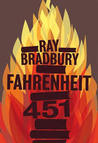
He wanted Montag to take that flame thrower and burn him mid-lecture. And as he writhed like a slug on the ground, some of the gibbering was in relief that he no longer had to live the charade of a fire chief who didn't want to burn books -- or bookworms -- any more than Montag did.
At least that was my feeling reading the book, this time through. And it's been a while since I read it. It's one of those books you read in high school and then put on the shelf and look at it from time to time, satisfied somehow that you read it. A long time ago. So when my daughter took it off the shelf to read it for school, I followed up with a reading once she was done.
And wow. Wow. What a book.
And while it oozes criticism of censorship and McCarthyism, it also oozes criticism of technology and the distractions it brings. The parlor shows, the drugs, the comic books, all meant to entertain without causing discomfort. And Montag revels in the destruction of it all.
"Fire!"
A great nuzzling gout of fire leapt out to lap at the books and knock them against the wall. he stepped into the bedroom and fired twice and the twin beds went up in a great simmering whisper, with more heat and passion and light than he would have supposed them to contain. He burnt the bedroom walls and the cosmetics chest because he wanted to change everything, the chairs, the tables, and in the dining room the silverware and plastic dishes, everything that showed he lived here in this empty house with a strange woman who could forget him tomorrow, who had gone and quite forgotten him already, listening to her Seashell Radio pour in on her and in on her as she rode across town, alone. And as before, it was good to burn, he felt himself gush out in the fire, snatch, rend, zip, rip in half with flame, and put away the senseless problem. if there was no solution, well then now there was no problem, either. Fire was best for everything!
Fire cleanses. Even the cleansing fire of the nuclear attack on the city he flees comes as a relief to him. It's a final cleansing spectacle that might possibly bring an end to the madness of the normalcy of the world he knew was ill.
And Rad Bradbury, famous luddite who rented a typewriter over nine days for a total of $9.80 to write this novel, I'm sure would be even more appalled at the state of technology, with computers and screens not limited to our homes, but appended to our bodies. And the surveillance state. And, more importantly, our willingness to be surveilled.
I read the last sixty pages at a gulp, all the time colliding with Bradbury's remarkable prose:
Millie was not here and the Hound was not here, and the dry smell of hay blowing from some distant field put Montag on the land. He remembered a farm he had visited when he was very young, one of the rare few times he discovered that somewhere behind the seven veils of unreality, beyond the walls of parlors and beyond the tin moat of the city, sows chewed grass and pigs sat in warm ponds at noon and dogs barked after white sheep on a hill.
Oh how the coastal elites of today, just as the city-dwellers in Montag's unnamed city, might look down their noses on those who live and work in the countryside. Not knowing, not caring that they might be more free, or at least have an opinion different than their own and reacting with disdain and bad humor when they discovered they do -- even if they bothered. Which those in Montag's city did not.
The country may be messy with farms and dogs and cows and leaves and mud, but to Bradbury, it feels more real. Montag might have had a much harder time burning a farmhouse -- then again, he may not have had to burn it at all, had he and Millie lived in one.
I’m a little bit of both, sagging somewhere in the middle.
What I don’t like is hypocrisy. From anyone. To see
Congressional Republicans shutting down an independent Congressional ethics
group in favor of a Congressionally-controlled panel, for example, makes me
cringe.
Update: Those of us who don't like this news have a powerful ally -- in the form of President-Elect Donald Trump.
So, too, does the liberal butthurt over the “Russian
hacking,” which I’ve already written about atlength.
Posit: If Wikileaks and Julian Assange, using information
provided by Russia, Russian intelligence agencies, or Russian-friendly groups,
had brought down the candidacy of Donald J. Trump rather than Hillary R.
Clinton, would I be hearing anything from the left on Russian hacking,
meddling, Assange-right-wing-shilling and the like?
If you said anything other than “token hand-wringing about a
foreign power trying to influence our election” I will laugh out loud. In your
face. And then take a deep breath and laugh out loud in your face. Again.
Because it would be the right whining about shilling meddling, and whatnot, and
not the left. The left would not be whining because their person would be the
President-elect. That’s the SAME REASON rank and file Republicans aren’t
whining. Because it’s their guy on the way to the White House.
Same goes for trusting our so-called intelligence agencies.
The left was in an uproar when CIA claims that Saddam Hussein had weapons of
mass destruction turned out to be bilge oil. NOBODY TRUSTS THE CIA, they
hollered. And hollered for years. Now that the CIA made a “discovery” in their
favor, the CIA is suddenly trustworthy again.
Posit: If there were a government program already
established to track legitimate visa-holders based on their country of origin
because that country supported or tolerated or winked at terrorism, what would
the left do with it?
If you said something other than “use the program itself”
I’d like you to read this.
Yes, President Obama dismantled the program after it fell
into disuse. In 2011. Three years after he took office. And after it was used
by the first Clinton administration and augmented after 9/11. But it was there
and there wasn’t anyone in power or with influence who was unduly upset enough
about it to do anything about it until just now.
Now am I being unfair picking on the left for their
hypocrisy? Yes. Because there’s plenty the right has done as well that stinks
just as bad or worse. But here’s the thing: I could go on at length about all
sides of the political spectrum stinking it up and NEVER COME TO AN END OF THE
EXAMPLES. We get the government we deserve, even when we’re righteously
indignant about the government that might yet come to pass.
So what to do? Preserve that righteous indignation. But use
it constantly. Don’t damp it down when your guy (or gal) is in power. Because
chances are your guy or gal is going to do something that stinks, and if you
don’t smell it, you dealt it, bro.
I could do many a thing with the first blog entry of 2017.
I could talk about goals. But we all know how well goals go.
I could talk about Doleful Creatures. But go back to that
comment about goals.
Scott Adams talks about systems rather than goals.
Not that Scott Adams should be consulted on everything.
Because, like all of us, he is an enormous wiener.
But goals for Doleful Creatures haven’t been working, as has
been noted by my supporters/critics, one of whom has published two books in the
time I’ve been tinkering with this one.
So what could be Doleful Creatures’ system?
Maybe the system should be to cut fluff from the story and
to concentrate on moving the plot and characters along. But that’s what I’ve
been doing already under the rubric of “goals,” which shows you can only take
Scott Adams’ advice only so far. I’m sure he’d have something else to say about
this, but he’s got his own cabbage to chew, and this is my plate.
I think the system is going to be to read it through at
least once, without the pen in hand. Just read it. No markings. And then see
how the story makes me feel at the end. Or wherever I give up reading it. And
then take it from there to make the next reading, without pen in hand, more
pleasant.
Well, that’s a system.
Or maybe I set it aside and use my poor editing skills on
The Hermit of Iapetus instead?
Nah.
One thing is for certain: Not skipping NaNoWriMo this year.
Done that for the past couple of years, as I’ve “edited”. You can see where
that’s got me.
Indy and Harry
-
We're heavily into many things at our house, as is the case with many
houses. So here are the fruits of many hours spent with Harry Potter and
Indiana Jone...
Here at the End of All Things
-
And another book blog is complete.
Oh, Louis Untermeyer includes a final collection of little bits -- several
pages of insults -- but they're nothing I hav...
Here at the End of All Things
-
I’ve pondered this entry for a while now. Thought about recapping my
favorite Cokesbury Party Blog moments. Holding a contest to see which book
to roast he...
Joseph Smith Rough Stone Rolling, by Richard Lyman Bushman. 740 pages.
Manhood for Amateurs, by Michael Chabon. 306 pages.
My Early Life, by Winston Churchill. 372 pages.
Nixon: Ruin and Recovery, by Stephen Ambrose. 665 pages.
Real War, The; by Richard Nixon. 341 pages.
Read in 2026
Al Capone does my Homework, by Gennifer Choldenko. 214 pages.
Americans at War, by Stephen Ambrose. 252 pages.
Astoria: John Jacob Astor and Thomas Jefferson's Lost Pacific Empire. 366 pages.
Bear that Wasn't, The; by Frank Tashlin. 64 pages.
Christmas Box Miracle, The; by Richard Paul Evans. 261 pages.
Complete Ripping Yarns, The; by Michael Palin and Terry Jones. 278 pages.
Cowboy and His Elephant, The; by Malcolm MacPherson.240 pages.
Cuckoo's Egg, The; by Cliff Stoll. 400 pages.
Dirks Escape, The; by C. Brandon Rimmer. 191 pages.
Dog for All Seasons, A; by Patti Sherlock. 244 pages.
Dragonhaven, by Robin McKinley. 342 pages.
Forever, Erma; by Erma Bombeck. 273 pages.
Gun Seller, The; by Hugh Laurie. 340 pages.
I Capture the Castle, by Dodie Smith. 343 pages.
J. Golden Kimball, the Story of A Unique Personality, by Claude Richards. 398 pages.
Kaboom Boys, The; by Elaine Hume Peake and Don Keith. 345 pages.
Last Battle, The; by Cornelius Ryan. 571 pages.
Malcolm at Midnight, by W. H. Beck, pictures by Brian Lies. 267 pages.
Mogo's Flute, by Hilda van Stockum. 87 pages.
One Corpse Too Many, by Ellis Peters. 285 pages.
Portable Door, The; by Tom Holt. 404 pages.
Possum that Didn't, The; by Frank Tashlin. 64 pages.
Rare Benedictine, A; by Ellis Peters. 150 pages.
Relativity: The Special and General Theory, by Albert Einstein. 164 pages
Social Contract, The; by Jean-Jacques Rousseau. 188 pages.
Take the Risk, by Ben Carson and Gregg Lewis. 236 pages.
Tales of the Peculiar, by Ransom Riggs. 190 pages.
There's Treasure Everywhere, by Bill Watterson. 173 pages.
Three Against Hitler, by Rudi Wobbe and Jerry Borrowman. 164 pages.
Town, The; by Shaun Prescott. 247 pages.
Unsung Heroes and Settlers of Bonneville County, Idaho; by Connie Otteson. 167 pages.
Walk in the Woods, A; by Bill Bryson. 397 pages.
Will Rogers Book, The; compiled by Paula McSpadden Love. 212 pages.
Ze Page Total: 8,518
The Best Part
Americans at War, by Stephen Ambrose
The Indiana and the Illinois units came over the barricade north of the railroad and captured a gun. Private James S. Adkins of the 33rd Illinois, exhilarated by the bloodless victory, leaped astride the gun tube, waved his elbows up and down at his sides, and crowed like a rooster. Then, curious, he tugged at the lanyard. The gun went off, hurling a shell close over the heads of the units coming up in support, and bucking Adkins head over heels into the dirt. Miraculously, no one was hurt.